101.09 Lesson 9
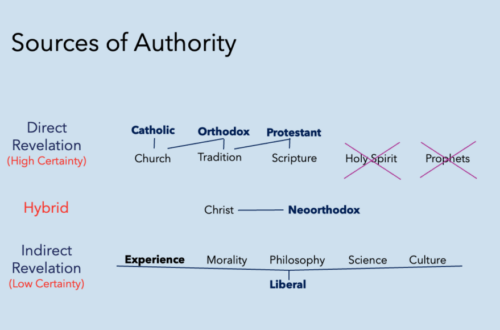
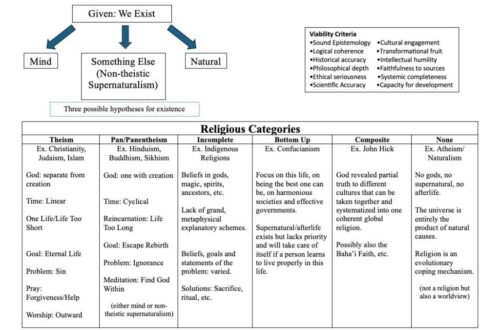
In lesson 4, I pointed out that human knowledge is the product of two inherently limited pathways: our senses and our reason, and the potential of a third: revelation. As life does not come with an instruction manual, we negotiate the interplay between these pathways by building models, each of which rests on different assumptions. And, rather than trying to demonstrate that one of these models is the correct one, we select the most plausible ones as simultaneously viable and then evaluate new models based on how they measure up to those already above the viability threshold.
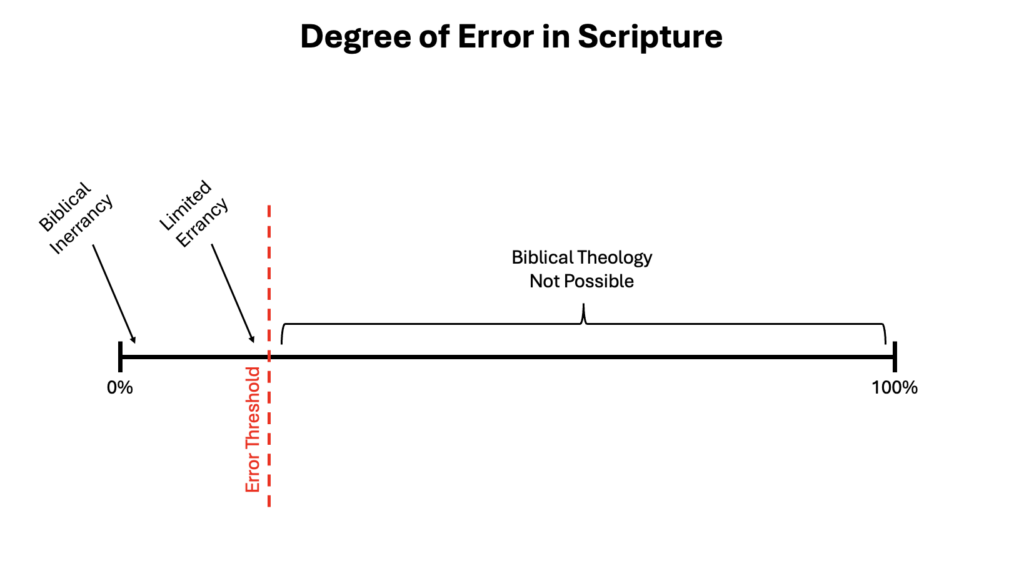
In Protestantism, the primary assumption is that God communicates theological knowledge via Scripture. However, multiple starting assumptions are possible regarding the nature of Scripture. If we were to set up a spectrum ranging from 0% to 100% Scriptural error, there would be some error threshold beyond which the Bible would have too many problems to still adequately function as a basis for theology. But it is not necessary for it to be 100% accurate to do this. In any situation where person A writes a message to communicate something to person B, some error may be introduced without preventing person B from understanding the message.
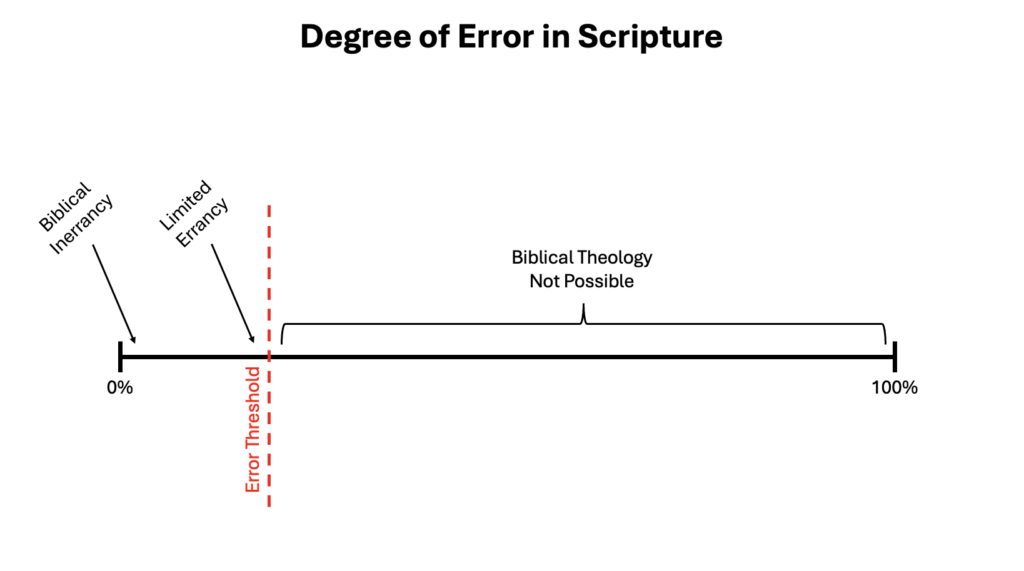
Therefore, if we drew an error-threshold line on our 0-100% Scriptural error graph, we could then assume that the actual degree of error in Scripture was closer to the 0% mark or closer to the error-threshold line. Inerrantists will naturally gravitate towards the 0% mark (at least in the original autographs) while I will instead move in the opposite direction, coming as close as possible to the error-threshold without crossing it.
The obvious benefit of this approach is that it makes it easier to engage with the arguments of critical scholars. The presence of errors in Scripture is no longer an automatic defeater of the Protestant position, requiring us to switch into apologetics mode for every possible objection. However, this initial assumption also affects how we view divine revelation/inspiration and how we approach the hermeneutical process.
When it comes to revelation/inspiration, inerrantists assume God fully controlled the communication process. Under a limited-errancy model, God gave the human agent much more autonomy in choosing how to convey the message. Under inerrancy, every data point in Scripture holds equal weight, and we must find a way to reconcile all of them. Under limited-errancy, we can ignore the anomalies and focus on the data trends instead (meaning theology must be more thoroughly canonical).
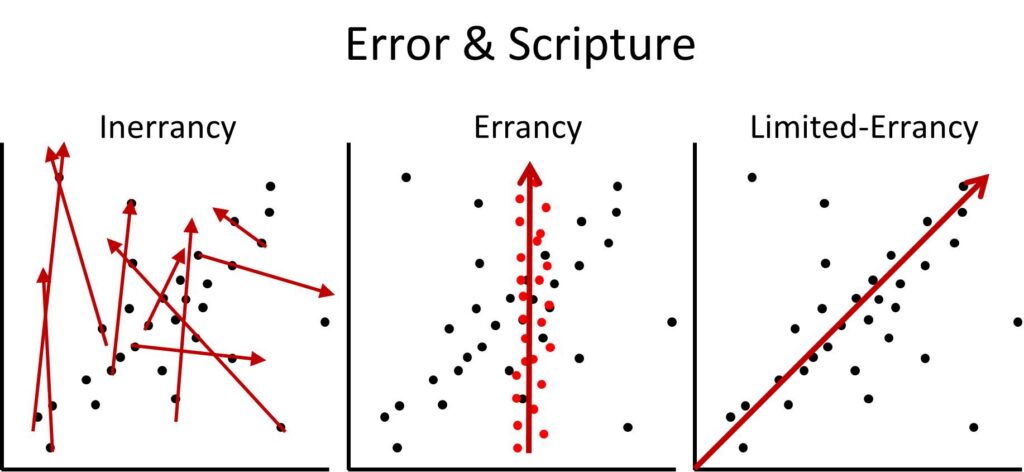
Given that we operate in a context of multiple viable models in constant competition, the most defensible version of the Protestant model is one that assumes limited errancy. This assumption, however, means that the best possible exegesis of any given passage does not have the final say in interpretation, as the Biblical author could have been mistaken. Every exegetical position, therefore, must be held as tentative until the full witness of Scripture is deciphered.
Thus, the first macro-hemeneutical assumption Adventists bring to Scripture is Limited-Errancy.
Common objections:
I will not go into too much detail here, as this is still an introductory-level course, but critics often point out that the Bible cannot be treated as a cohesive document because it was written by many people over many centuries in different places and cultural contexts. This is not, in itself, a defeater, as it is still possible for a single primary author to communicate through multiple secondary authors in this way. Consider a mosaic in which pieces of many shapes (squares, triangles, circles, etc.) and multiple colors could be used to create a portrait of a person. Or that someone could communicate a set of ideas to someone else by giving them a library reading list.
Another objection is that the biblical documents were written much later than they claim. The assumption here, however, is that the persons, events, and ideas described were in fact historical, but due to language constantly changing and the inability to preserve written documents for more than a few decades, these ideas had to be continuously rearticulated and even expanded upon in order for them to make sense to later generations. God, however, did not feel that the key message was sufficiently distorted through this process to intervene.
It is helpful to also remember that every theoretical model rests on foundational assumptions that are equally susceptible to similar critique.
Recommended reading:
Canonical Theology by John Peckham – a more thorough description of the Adventist theological method.
The Cognitive Principle of Christian Theology by Fernando Canale – a more thorough description of the Adventist View of Revelation/Inspiration.