101.07 Lesson 7
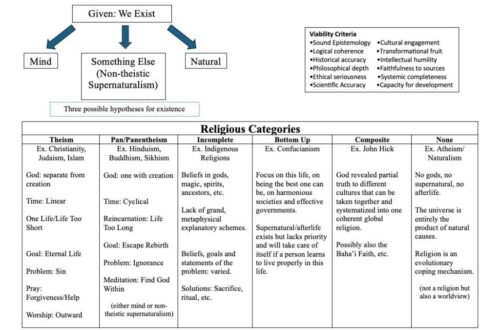
In previous posts, I introduced an approach to epistemology in which multiple theoretical models (worldviews) can be classified as simultaneously viable. I then explained that atheistic naturalism can be one of these models and that other world religions can also have viable models. In this lesson, I will explain that multiple models exist in Christianity (as might in other religions) and describe what those models are.
If we trace the development of Christian theology historically, we begin with the Catholic/Orthodox model going back several centuries after the time of Christ. The Protestant model was introduced in the middle of the second millennium, while the Liberal model emerged during the Enlightenment. Finally, at the turn of the previous century, two additional models developed in response to Liberal Christianity: Fundamentalism and Neoorthodoxy. These are not the only possible models in Christianity, but they seem to be the most prevalent and are useful for creating a categorization schema. Moreover, it might appear that the models overlap at times, but their centers of gravity remain distinct.
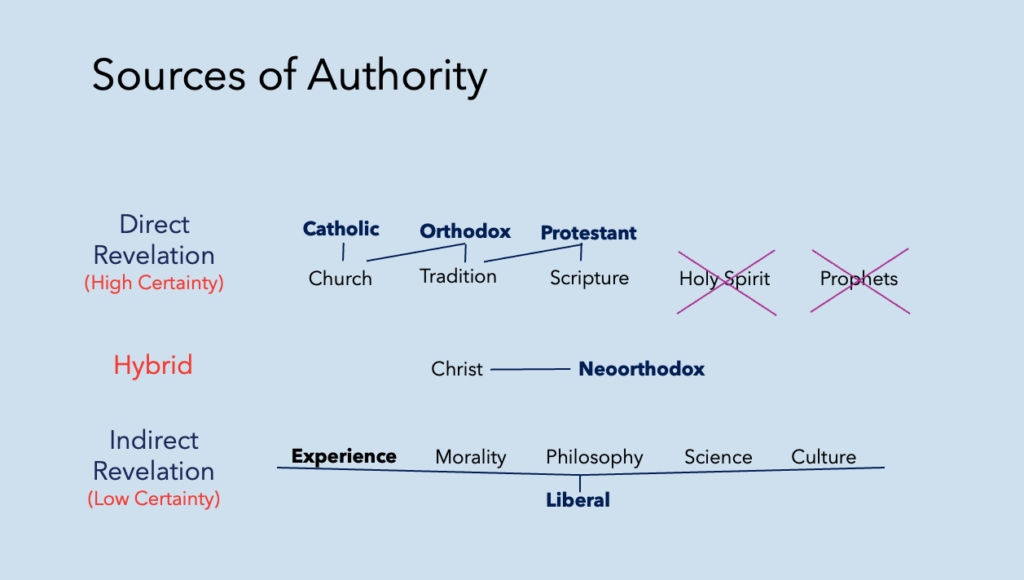
The best way to understand these models is via their sources of authority. Christianity has had several potential sources of authority, such as Scripture, tradition, the church leadership, the Holy Spirit, and prophets. Attempts to build Christian traditions on prophets or the Holy Spirit have not been successful, so most mainstream Christians work with some combination of Scripture, tradition, and church leadership. Catholics prioritize leadership (apostolic succession), the Orthodox seem to place more emphasis on tradition, while Protestants prioritize Scripture (I keep Catholic and Orthodox theologies together because, in spite of this distinction, they are still very similar compared to the other models).
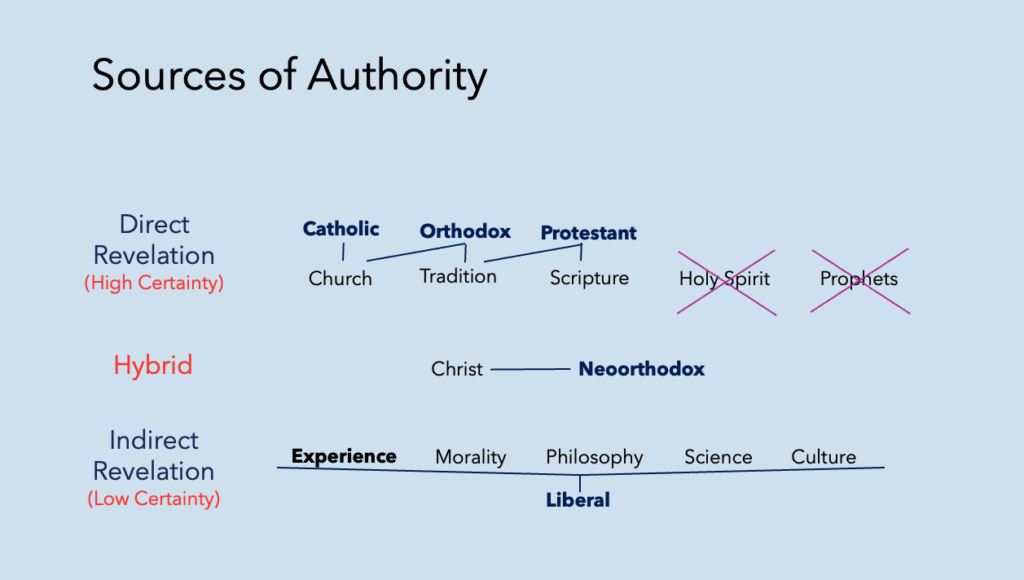
However, what if someone no longer trusts any of these authority sources? Must they give up on Christianity? Liberal theology insisted that we can still have this deep inner sense of dependence on God and build our theology on that. We can rely on secular knowledge sources such as science, philosophy, culture, etc., but interpret them through the lens of our personal experience with God. But while this approach was satisfactory for some, for others it seemed like things had gone too far, and Liberal Christianity had moved too far off from what Christianity was initially intended to be. Some, such as the fundamentalists, reacted by simply dismissing Liberal critiques of traditional Christianity (ex. higher criticism questioning the reliability of Scripture or the theory of evolution questioning the creation story) and taking a head-in-the-sand approach instead. Their anti-intellectual, anti-science stance can be summarised as ‘The Bible said it, I believe it, that settles it.’ Neoorthodoxy, on the other hand, adopted a more hybrid approach, accepting the overall Liberal epistemic foundation but arguing that it isn’t necessary to completely discard previous authoritative sources; they can be viewed as inspired only to the extent that they point to Jesus.
Christians have been debating these models for decades, with sides often viewing each other as irrational or heretical. More conservative models tend to struggle with objections coming from modern scientific advancements, while liberal models lack substance and continuity with historic Christianity. Instead of getting caught up in these endless debates, I place all models, except for Fundamentalism, above the viability threshold on my chart. The final graphic then looks something like this:
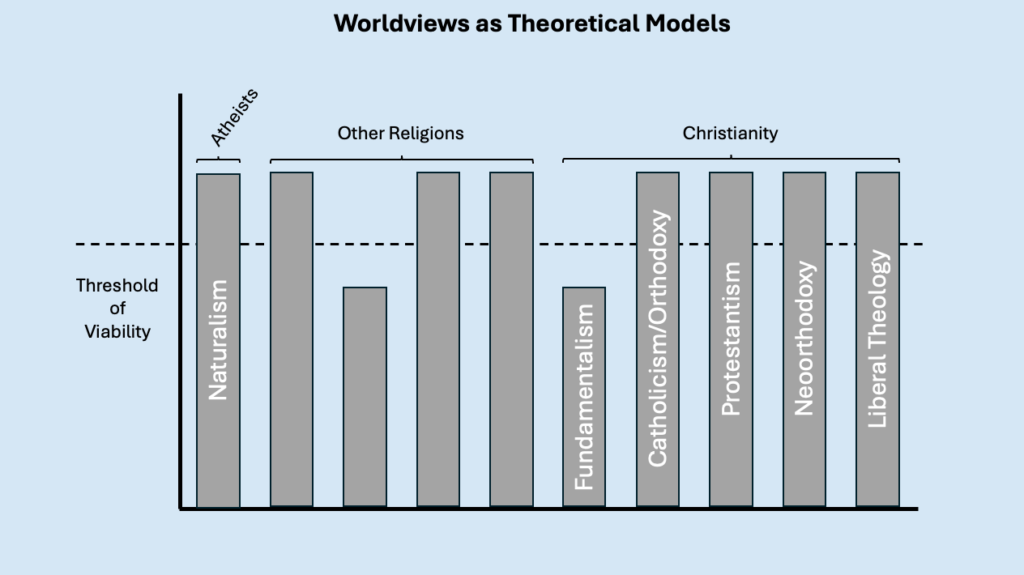
This viability chart creates space for open communication among conflicting points of view, much like Roger Olson’s schema, introduced in the second lesson, allows for a variety of Christian perspectives. Olson’s schema classifies individual beliefs as Christian or heretical, whereas my schema classifies entire theoretical models as reasonable/unreasonable hypotheses for reality as a whole. I am not dogmatic about this particular arrangement; if someone thinks some models should be added or excluded, I am open to that conversation. But I am not interested in people who dismiss all but their preferred model, or who criticize but never take a stance. And it is important to have this conversation before moving on to the next lesson, where I begin to position the Adventist perspective among these other perspectives.
Recommended Reading:
Though not exactly going in the same direction, this book is an interesting survey done by the World Council of Churches evaluating the authoritative sources in a wide variety of Christian traditions: