101.04 Lesson 4
There are thousands of religions and philosophical outlooks in the world, and each can often be broken down into many additional subgroups. The factor most responsible for this variety of perspectives is epistemology (their theory of knowledge). I perceive Adventism, first and foremost, as a critique of common approaches to epistemology, whether Christian, non-Christian, or secular.
I begin all my religion classes with a conceptual exercise that goes something like this: Imagine that you are drugged, kidnapped, and wake up in a very large room with thick concrete walls, and no doors or windows. You have no idea how you got there, who put you there, or why. What do you do?
After thinking about it for a bit, most students say they would look around the room for any way out or for clues. Essentially, they would be using their senses in an attempt to gather information: they might feel or knock on the walls to see if there are any cracks or weak spots; they might put their ear to the wall to check if they can hear anything outside; they might look around very carefully in case they come across anything significant, etc.
If, however, that investigation proves fruitless, there is still more they can do. They can use their reason and imagination to develop plausible scenarios for why they are there. Students usually propose situations such as: someone is playing a practical joke, they were simply kidnapped for ransom, someone is trying to get even with them for something they did, this is some type of mad scientific experiment, this is one of those weird game shows that extremely rich people pay to watch, etc.
Our senses and our reason constitute the two pathways to knowledge that human beings have. Our senses give us direct information about our environment, though they have limited reach (in this case, they can’t get past the wall). Our reason can reach beyond the limitations of our senses via imagination, but this form of knowledge is speculative; we can come up with possible scenarios, but have no way of knowing which of them is correct. Beyond these two pathways, we have no additional mechanisms for knowledge gathering. After looking around the room and considering possible scenarios, there’s nothing more we can do; we have reached our epistemic limits. We call sensory knowledge science and rational knowledge philosophy.
Returning to the concrete room analogy, we have so far established what kidnapped individuals could do on their own. But let’s imagine that after several hours of searching around and speculating about possible explanations, the person who kidnapped them finally speaks up (for the sake of the analogy, imagine a hidden speaker somewhere on the tall ceiling). Because the kidnapper is responsible for the current predicament, he obviously knows where they are and why they are there, and can reveal this information to the victim.
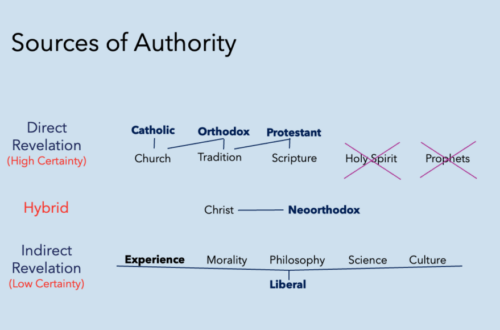
In the same way, if a God exists, this God could reveal to us knowledge we could not access on our own. Of course, this would open a whole new set of questions about what the mode of that revelation should be, which of the available contenders would be the correct one, and how exactly that revelation should be interpreted. Regardless, all religious-philosophical outlooks consist of some combination of theology, philosophy, and science, even if some pathways are brought up only to be dismissed. Moreover, outlooks that prioritize experience (liberal theology) and reason (natural theology) over direct revelation are not inherently more rational, as they merely assert that experience and reason are their modes of revelation.
Virtually all problems in epistemology are due to either ignoring one or more of these pathways or overestimating/underestimating their value. Natural theology proponents, for example, often overestimate philosophy’s capacity to arrive at a correct understanding of reality. At the other extreme, people who usually come from a science background will dismiss philosophy altogether. Some will arbitrarily choose a source of divine revelation as undeniably true, while others will reject all revelation. Still others, recognizing our epistemic limitations, will deny the possibility of knowledge in general, taking a skeptic, agnostic, or postmodern relativist stance.
Below, I will briefly introduce a more robust approach to epistemology. Though somewhat complicated for this introductory lesson, I just want to give advanced readers some idea of the direction I plan to eventually take things. For everyone else, the main point of this lesson is to establish a basic foundation of epistemic humility: human beings have severe limitations in their capacity to acquire knowledge.
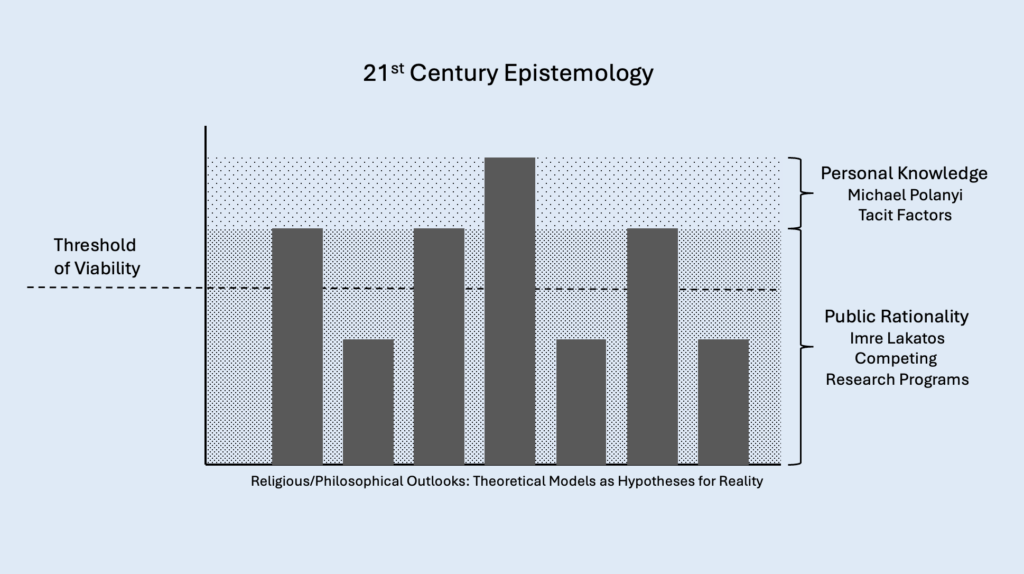
With that said, the epistemic framework I am proposing engages with religious/philosophical outlooks as holistic theoretical models or, in essence, as complete systems of thought that function as hypotheses for reality. Because we cannot treat all hypotheses equally, we have to differentiate between plausible and implausible (viable/non-viable) theoretical models. Given our epistemic limitations, we should abandon the idea that a single correct view of reality is possible. We must instead determine which worldviews meet a certain threshold of viability and make peace with treating these as simultaneously viable perspectives. Imre Lakatos’ (an influential philosopher of science) analogy of ‘competing research programs’ can provide the underlying theoretical framework.
Since we lack tools to determine which model is correct, debates between models are a complete waste of time. We should instead focus on developing sound viability criteria to determine which models are viable and which aren’t. We can debate what the criteria should be and which models qualify as viable based on them, but we cannot then prove that any of the viable models is the correct one in a universally applicable way. Possible viability criteria might include sound epistemology, logical coherence, scientific accuracy, philosophical depth, systemic completeness, historical accuracy, intellectual humility, faithfulness to sources, ethical seriousness, cultural engagement, transformational fruit, capacity for development, etc.
Of course, most individuals cannot function in an agnostic or pluralistic stance and must orient their lives around a single perspective. To accomplish this, their epistemic duty is to first evaluate all viable models fairly and then decide among them based on tacit factors (i.e., Michael Polanyi – see below). For secular individuals, this might mean intuition, while for religious people, a sense of divine guidance, etc. Human rationality must be broken down into public rationality and private personal knowledge, and only through private knowledge can individuals achieve any sense of certainty.
Recommended reading:
A Philosophy of the Christian Religion by Nancy Murphy gives an overview of the history of epistemology and introduces the Lakatosian research programs as the postmodern solution.
Below are the books, The Structure of Scientific Revolutions by Thomas Kuhn, and The Methodology of Scientific Research Programmes by Imre Lakatos.
Below are the books Personal Knowledge by Michael Polanyi, and two books based on Polanyi’s work, Longing to Know by Esther Meek, and Biblical Knowing by Dru Johnson.
In this post I have merged Murphy’s views and her influences with those following Polanyi’s approach into a single epistemic framework.