101.06 Lesson 6
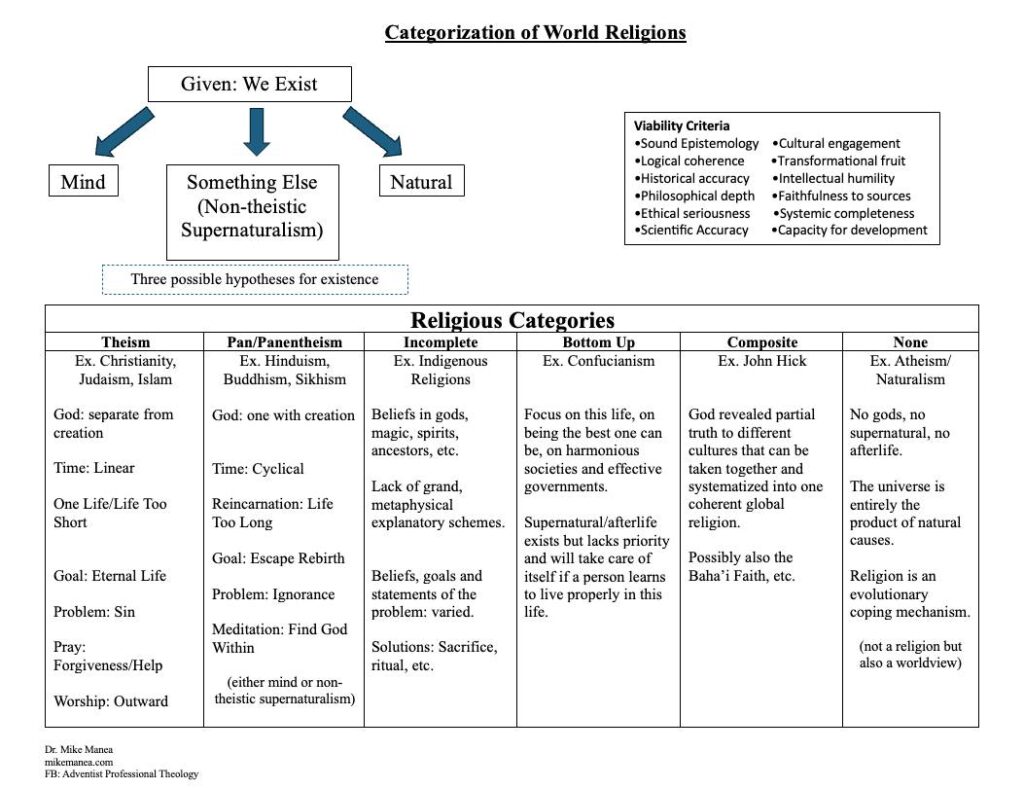
As over the years I have tried to make sense of the inner logic of the various world religions, I have also tried to develop a simple categorization scheme for their various perspectives. The chart below is what I currently use in my classes, though I tend to make minor changes every few months as I continue learning. Probably the most significant distinction for our current purposes is between theistic (Judaism, Christianity, Islam) and pantheistic (Hinduism, Buddhism, Sikhism) religions. This one distinction – whether reality is part of God or created by God as separate from Himself – seems to produce very different religions/philosophies, to the point where adherents have a difficult time even understanding each other. Nonetheless, both perspectives have produced comprehensive worldviews that could be articulated as viable theoretical models.
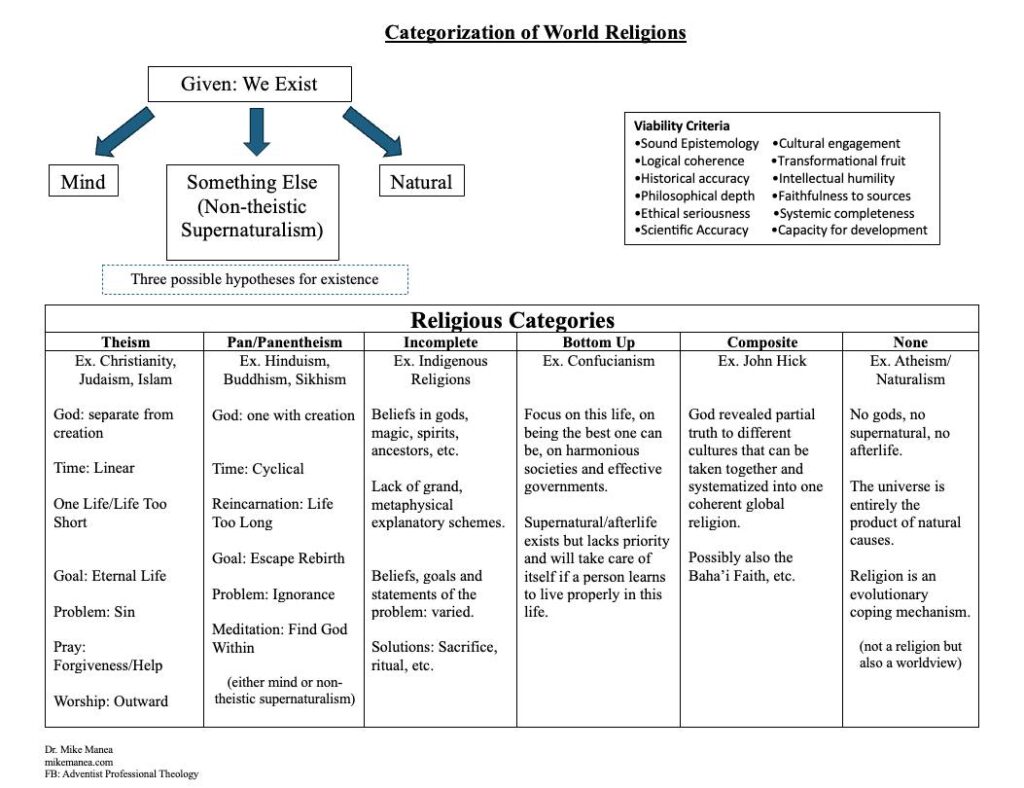
The chart first builds on the material covered in the previous lesson. We start with what we know: that we exist. We offer several hypotheses for this, such as Naturalism – the hypothesis that the universe developed entirely through natural causes from beginning to end – Theism – the hypothesis that the universe was engineered by a mind that has always existed, and Non-theistic Supernaturalism – the catch-all hypothesis for anything that doesn’t qualify either as a mind or as natural. Atheists/naturalists, then, tend to build their worldview on the naturalistic hypothesis. The other worldviews are built on either theistic or supernaturalist hypotheses.
‘Incomplete’ religions don’t have a fully worked-out metaphysics; they might postulate certain supernatural entities, but without explaining what these entities are or where they come from. Bottom-up religions are similar in that they might allow for the supernatural without trying to understand it, but this is an intentional epistemic stance, given our inability to access the supernatural realm. Instead, they focus their attention on how people should live in the world.
In more recent years, as people have had a chance to learn of and appreciate the many world religions, some have tried to create composites by taking the best parts from different religious perspectives with the idea that God has revealed Himself to everyone in some way. Finally, as already mentioned, some of the most popular world religions can be distinguished by whether they view God as one with creation or separate from it. This distinction affects how they then understand time, sin, morality, the afterlife, etc.
I will not go into more detail on other religions at this time, but for those interested, below is a short introduction I have used in my classes. It is, however, important to understand the inner logic of other religions, even when primarily focused on Christianity, because ideas that seem similar at face value are often very different at a more fundamental level. For example, the Christian concept of God becoming human means something very different in Hinduism, where the Gods are already one with creation.
Recommended reading:
World Religions: A Beginner’s Guide, by Jill Carroll.